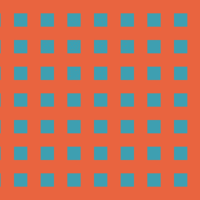
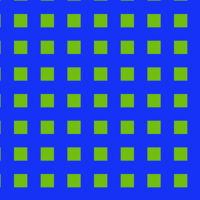
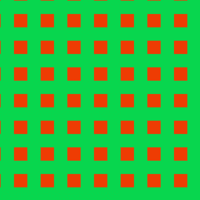
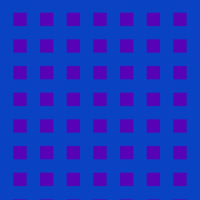
 An equiluminance demonstration for the Spring 2006 midterm exam.
March 8 2006
Equiluminance is an optical illusion capitalizing on a disagreement between the two vision systems of the human brain: “what” and “where”. The “what” system is a higher-level process that detects color and differentiates between objects. The “where” system is an older, instinctive process that detects grayscale and movement. The “where” tells you something is moving, while the “what” tells you it is a man wearing a blue coat.
Luminance is the strength, sometimes called the “alpha”, of the overall color: low luminance is close to black while high luminance is close to white. When a color image is converted to grayscale the red, green, and blue luminance values are averaged together into one luminance between black and white. Thus colors with the same average, even if they are completely different in hue, are the same in grayscale and the edge derived from the contrast between the colors is lost.
The illusion of occurs when the “what” and “where” systems see different images. The “what” sees a clear contrast between the colors and shapes, however the “where” cannot discern the same amount of contrast since it sees in grayscale. Part of the brain is saying “there is something there”, while the other “there is nothing”. The result being that the edges between the colors are indefinite and appear to move. These images can be uncomfortable to look at for long.
Artists discovered this illusion and have used it to add depth and life to their work, most notably the Impressionists and Modern Art.
Many websites utilize this effect as a design feature, yellow text on a blue background for example.
———————————————————————-
Here are a few examples from the program, which generates 2 equiluminant colors: 1 on the background and 1 on the squares.